WhatsApp Service Conversations Are Getting Charged.
Here's how to keep them FREE

Meta has confirmed that starting October 1, the WhatsApp Business Platform will charge per message for two categories that have been free since 2024: service messages (the free-form replies a business sends inside an open 24-hour customer service window) and utility template messages sent inside that same window.
Both will bill at the same per-message rate already applied to templates sent outside the window — rates that vary by country.
There is a buffer, though it's easy to miss: each business phone number gets 1,000 free service messages a month before any of this kicks in, and the allowance resets monthly.
What isn't changing: messages customers send to a business stay free, as they always have.
What most businesses will get wrong about it
The natural reading is "WhatsApp is charging for replies now" — full stop. That's not quite right, and the part that's missing is the part worth knowing before your next bill.
The charge applies specifically to messages sent through the WhatsApp Business Platform (the API) — and that includes both a chatbot's automated reply and a human agent typing back through an API-connected inbox. It's not about who or what answered; it's about which channel carried the message. It doesn't touch the free WhatsApp Business App at all — a business owner replying manually from their phone, without ever going through the API, sees no bill.
That distinction matters most for a business still running purely on the Business App today, weighing whether to connect the API for automation. The usual worry is: "if I upgrade, doesn't everything I send suddenly cost money?"
It doesn't.
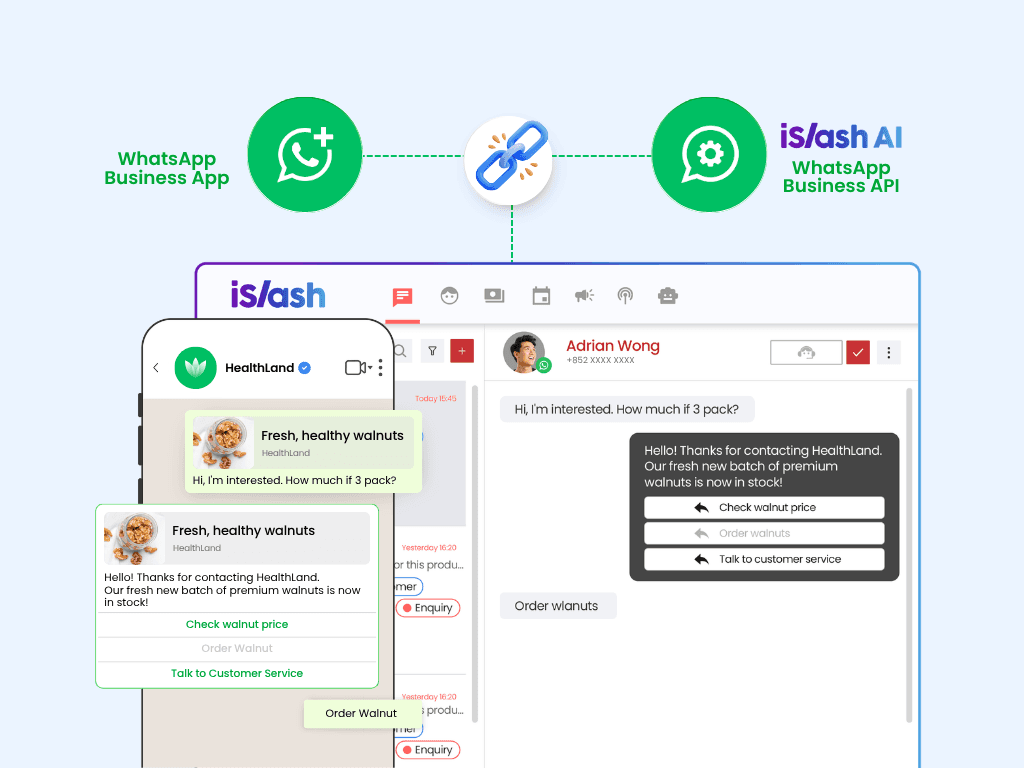
Under Coexistence mode, a business connects its existing number to the API for automation while its team keeps replying manually from the Business App on the same number — and messages sent from the App side don't open, close, or extend an API conversation window at all. They run on a separate track, and they stay free, October 1 or not.
The fee isn't attached to the conversation. It's attached to the channel you use to have it — and that's a choice, not a fixed cost of doing business on WhatsApp.
You don't need to give up your number or start over to add this kind of automation. If you're running your business on the free WhatsApp Business App today, you can keep that exact number, connect the API, and keep everything that made it useful in the first place — your chat history and contacts carry over, and the App and the API side stay in sync on the same number. Nothing about how customers already reach you has to change. What changes is what you now have room to build on top of it.
Where the real payoff sits
The mistake would be treating October 1 purely as a bill to minimize. The better question is: once a message costs something, does it earn back more than it costs?
A few flows clearly do:
AI Agent auto-reply — handles the repetitive, first-line questions instantly, so the messages that do get billed are ones that would have cost staff time anyway, not ones a bot should have caught for free.
Payment inside WhatsApp — a customer moves from chat, to order, to paying, without ever leaving the conversation. A billed message that ends in a completed sale isn't a cost, it's a transaction.
WhatsApp Forms — a customer fills in the details you need directly inside the chat, with no jump to an external link where half of them disappear. You collect the same information, and keep the customer, in one place.
Booking — a customer picks and confirms an appointment slot inside the same conversation, with no scheduling link and no back-and-forth to lock in a time. The billed message is the one that fills a calendar slot, not one that just keeps a thread going.
Coupons (OMO) — a promo code sent inside the conversation gets redeemed either at checkout online or in-store, turning a WhatsApp chat into a working online-to-offline sales channel. For e-commerce and retail businesses especially, the billed message is the one that closes a sale, not an administrative reply.
Team Message Inbox — when replies are still handled manually, a shared inbox makes sure every one of those now-billed messages is assigned, tracked, and answered once — not duplicated by two agents replying to the same customer, or left sitting long enough that the customer has to message again. Once every reply has a cost, a wasted message is a cost with nothing to show for it.
The takeaway
Nothing forces you to choose between keeping the number your customers already know and getting more out of it. Keep the number, keep the history, upgrade what sits behind it.
Spend the new per-message cost only on the handful of things — auto-reply, in-chat payment, forms, booking, coupons — that were always going to pay for themselves, backed by a shared inbox that makes sure none of it gets wasted. And for the routine, one-off replies that don't need any of that machinery, the Business App side stays exactly as free as it's always been.
One more thing
There's a second change coming that hasn't gotten nearly as much attention as the October 1 pricing update: Meta has confirmed the free entry-point window — the free messaging period that opens when someone reaches you through a Click-to-WhatsApp ad or a Facebook Page button:
is being extended from 72 hours to a full 7 days.
Any type of message, templates included, sent inside that window costs nothing.
A week is a genuinely useful amount of time to take someone from "clicked an ad" to "qualified, quoted, or booked" — well before any per-message charge ever becomes relevant to that conversation.
Try Free Plan and see which of your WhatsApp conversations are already worth the upgrade!